

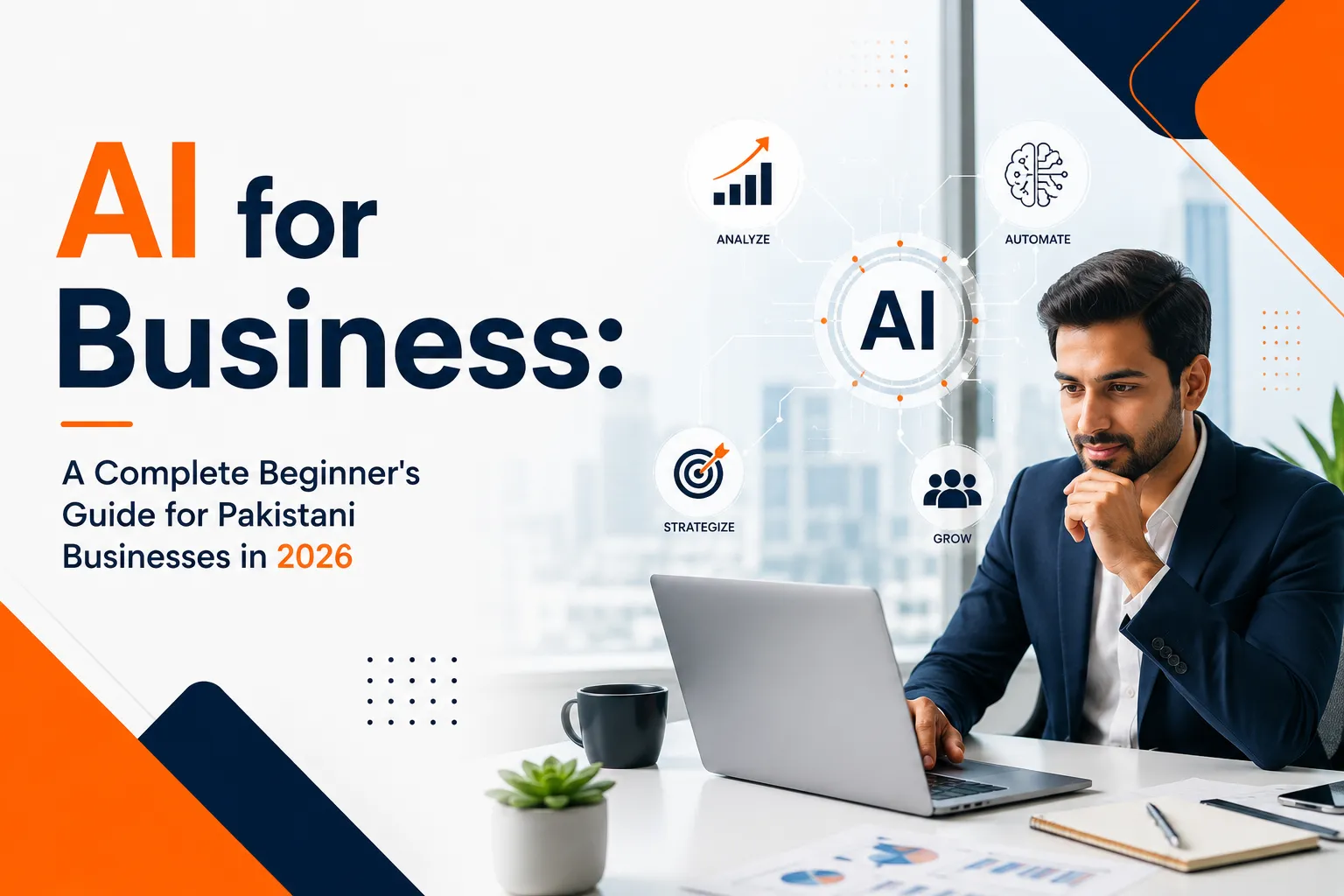
AI for Business: A Complete Beginner’s Guide for Pakistani Businesses in 2026

Introduction
If you’ve been hearing everyone talk about Artificial Intelligence (AI) but you’re still wondering whether it actually matters for your business, you’re not alone.
Many business owners think AI is only for large multinational companies with massive budgets and dedicated IT teams. Others believe it’s too technical, too expensive, or simply another technology trend that will fade away.
The reality is very different.
AI is no longer a technology of the future, it’s becoming an everyday business tool. Whether you own a manufacturing company, run an export business, manage a retail store, operate a service-based company, or are building a startup, AI can help you work smarter, save time, and improve productivity without increasing your workforce.
Think about how much time you and your team spend every week writing emails, creating marketing content, responding to customer inquiries, preparing proposals, organizing meetings, researching competitors, or analyzing business data. These tasks are important, but they often consume hours that could be spent on strategic planning, sales, customer relationships, or business growth.
This is where AI creates real value.
Instead of replacing your team, AI acts like an intelligent business assistant that helps you complete repetitive tasks faster while allowing your employees to focus on work that requires creativity, critical thinking, and human expertise.
The businesses that start learning and implementing AI today won’t just save time, they’ll build a competitive advantage that becomes increasingly valuable over the coming years.
In this guide, you’ll learn what AI for business really means, how it works, why businesses across different industries are adopting it, and the practical ways you can start using AI to improve your daily operations.
What Is AI for Business?
Quick Answer
AI for Business refers to the use of Artificial Intelligence to automate repetitive tasks, improve decision-making, analyze data, create content, enhance customer service, and increase overall business efficiency. Rather than replacing people, AI helps businesses complete routine work faster so teams can focus on higher-value activities.
In simple words, AI helps your business do more with the resources you already have.
Imagine having an assistant that can help you write emails, summarize meetings, generate marketing ideas, draft proposals, organize information, and answer common questions within seconds.
That’s exactly how many businesses are using AI today.
However, one important thing to understand is that AI should support your business, not run it.
Your experience, industry knowledge, and decision-making skills remain irreplaceable. AI simply helps you execute tasks more efficiently.
Why Every Business Should Pay Attention to AI in 2026
Business has changed dramatically over the past few years.
Customers expect faster responses.
Competition has increased across almost every industry.
Marketing costs continue to rise.
Businesses are expected to produce more content than ever before.
At the same time, business owners are constantly looking for ways to improve efficiency without significantly increasing operational costs.
This is exactly why AI has become one of the most valuable business tools available today.
Let’s consider a simple example.
Imagine two companies offering similar services.
The first company spends four hours every week creating social media content, replying to customer emails, writing proposals, and organizing internal documents.
The second company uses AI to complete the first draft of these tasks in less than an hour.
Both companies still rely on human expertise to review, refine, and approve the final work. However, the second company now has three extra hours every week to focus on sales, customer relationships, business development, or improving its products and services.
Over the course of a year, those saved hours become a significant competitive advantage.
This is why AI isn’t just about automation.
It’s about improving productivity.
It’s about helping your team spend more time on work that actually grows your business.
AI Is Changing the Way Businesses Operate
Businesses across different industries are already integrating AI into their daily workflows.
Manufacturers use AI to analyze production data.
Exporters use AI to draft professional emails and product descriptions for international buyers.
Marketing agencies use AI to accelerate content creation and campaign planning.
Customer support teams use AI-powered chat assistants to answer common questions.
HR departments use AI to write job descriptions and screen resumes.
Finance teams use AI to summarize reports and identify spending patterns.
Notice something important?
None of these businesses are replacing their employees.
They’re helping their employees become more productive.
That’s a major difference.
Businesses that understand this concept are much more likely to benefit from AI than those expecting it to perform miracles.
AI Is No Longer Just for Large Companies
One of the biggest misconceptions about AI is that it’s designed only for enterprise organizations.
In reality, small and medium-sized businesses often gain the greatest benefits.
Why?
Because smaller teams usually handle multiple responsibilities.
A marketing manager may also write website content.
A business owner might personally respond to customer inquiries.
A sales executive may also prepare quotations and presentations.
When AI reduces the time required for these repetitive tasks, the entire business becomes more efficient.
Instead of hiring additional staff immediately, many businesses can first optimize the productivity of their existing teams.
This makes AI particularly valuable for startups, SMEs, exporters, and growing businesses across Pakistan.
Common Myths About AI
Before you decide whether AI is right for your business, let’s address some of the biggest misconceptions.
Myth 1: AI Will Replace All Employees
This is probably the most common concern.
The truth is that AI is excellent at handling repetitive, predictable tasks.
However, it cannot replace strategic thinking, leadership, creativity, negotiation, emotional intelligence, or relationship building.
For example, AI can draft a marketing campaign.
But it cannot fully understand your customers, your brand positioning, or your long-term business vision the way an experienced marketing professional can.
Businesses that combine human expertise with AI productivity will almost always outperform businesses that rely entirely on either one.
Myth 2: AI Is Too Expensive
Many business owners assume implementing AI requires huge investments.
Fortunately, that’s no longer true.
Many of today’s most powerful AI tools offer free versions or affordable subscription plans that provide excellent value for small businesses.
In many cases, the time saved each month is worth far more than the subscription cost.
Instead of thinking about AI as an expense, think about it as an investment in productivity.
Myth 3: AI Is Too Complicated
Another misconception is that only programmers or IT professionals can use AI.
Modern AI tools are designed for everyday business users.
If you can type a message, search on Google, or send an email, you already have the basic skills needed to start using AI.
Learning how to ask better questions or write better prompts is often more important than having technical knowledge.
Myth 4: AI Always Gives the Right Answer
This is one of the biggest mistakes businesses make.
AI is incredibly powerful, but it isn’t perfect.
Sometimes it misunderstands your request.
Sometimes it generates outdated or inaccurate information.
Sometimes it lacks the context of your business.
That’s why AI should always be viewed as an assistant, not an authority.
Always review, verify, and refine AI-generated content before using it in your business.
Your expertise should always guide the final decision.
How AI Works (Without the Technical Jargon)
Many people assume AI works like magic because the results appear almost instantly.
In reality, AI works by identifying patterns from vast amounts of information and using those patterns to predict the most relevant response to your request.
Imagine hiring an assistant who has read millions of books, articles, reports, and conversations.
When you ask a question, that assistant quickly identifies patterns from everything they’ve learned and generates a helpful response.
That’s a simplified way of understanding AI.
For example, if you ask AI to write a professional email to a potential customer, it doesn’t copy an existing email from the internet.
Instead, it understands the structure, tone, language, and purpose of professional business communication, then generates a new response based on those patterns.
The better your instructions, the better the output.
This is why businesses that learn how to communicate effectively with AI often achieve much better results than those using vague prompts.
Key Takeaways
Artificial Intelligence isn’t about replacing people.
It’s about helping people become more productive.
Businesses that understand how to combine human expertise with AI-powered efficiency can reduce repetitive work, improve customer experiences, and create more opportunities for growth.
In the next section, we’ll explore the practical ways AI can help your business every single day, regardless of your industry or company size.
10 Practical Ways AI Can Help Your Business
Now that you understand what AI is and why businesses are adopting it, let’s look at where it creates the biggest impact.
One of the biggest misconceptions about AI is that it completely transforms a business overnight.
It doesn’t.
Instead, AI improves dozens of small tasks that your team performs every day. Individually, these improvements may seem small, but together they can save hundreds of hours every year.
The following examples apply to almost every business, whether you’re running a manufacturing company, export business, retail store, software house, digital marketing agency, educational institute, or service-based company.
| Business Function | How AI Helps | Business Benefit |
| Customer Support | Answers common questions instantly | Faster response times and improved customer satisfaction |
| Marketing | Creates content ideas, ad copy and campaigns | Saves time and improves consistency |
| SEO | Keyword research, content planning and optimization | Better organic visibility |
| Email Communication | Drafts professional emails | Faster communication |
| Sales | Creates proposals and follow-ups | Improves productivity |
| HR | Writes job descriptions and interview questions | Simplifies hiring |
| Data Analysis | Summarizes reports and identifies trends | Better decision-making |
| Meeting Management | Generates meeting summaries and action points | Keeps teams aligned |
| Documentation | Creates SOPs, manuals and reports | Improves internal processes |
| Business Research | Competitor and market research | Better strategic planning |
1. Improve Customer Support Without Increasing Your Team
Customers expect quick responses.
Whether someone contacts you through WhatsApp, email, your website, or social media, waiting several hours for a reply often means losing a potential customer.
AI can help by answering frequently asked questions, drafting personalized responses, categorizing support tickets, and assisting your customer service team with faster replies.
For example, if your business receives the same questions every day, such as pricing, delivery times, business hours, or product specifications, AI can generate accurate responses within seconds.
Your team can then focus on handling complex customer issues that require human judgment.
Business Impact
Instead of replacing your support team, AI allows them to help more customers in less time while maintaining service quality.
2. Create Better Marketing Content Faster
Content marketing has become one of the most effective ways to attract customers.
However, creating quality content consistently isn’t easy.
Businesses need blog posts, website content, social media captions, advertisements, email campaigns, newsletters, videos, and product descriptions.
Producing all of this manually requires significant time and resources.
AI can assist by helping you:
- Generate content ideas
- Create blog outlines
- Write first drafts
- Improve headlines
- Rewrite existing content
- Repurpose one article into multiple formats
For example, one blog can become:
| Original Content | Repurposed Into |
| Blog Article | LinkedIn Posts |
| Blog Article | Facebook Posts |
| Blog Article | Instagram Carousel |
| Blog Article | YouTube Script |
| Blog Article | Email Newsletter |
| Blog Article | Short Video Script |
This doesn’t eliminate the need for human creativity.
Instead, it gives your marketing team a much stronger starting point.
3. Improve Your SEO Strategy
Many businesses think AI can simply write an article and rank it on Google.
That’s not how SEO works.
Successful SEO still requires strategy, keyword research, search intent analysis, competitor research, internal linking, EEAT optimization, and regular content updates.
However, AI can significantly speed up many of these activities.
For example, AI can help you:
- Discover content ideas
- Generate topic clusters
- Create SEO-friendly outlines
- Suggest semantic keywords
- Improve readability
- Generate FAQ ideas
- Optimize meta descriptions
Think of AI as your SEO assistant not your SEO expert.
The strategy should always come from experienced professionals.
4. Write Professional Business Emails
Many professionals spend a surprising amount of time writing emails.
Whether you’re responding to customers, following up with leads, communicating with suppliers, or contacting international buyers, professional communication matters.
AI can draft:
- Sales emails
- Follow-up emails
- Complaint responses
- Meeting invitations
- Proposal emails
- Partnership requests
Instead of staring at a blank screen, you can review and personalize a high-quality draft within minutes.
5. Generate Better Business Proposals
Preparing proposals often requires collecting company information, explaining services, defining project scope, and presenting pricing professionally.
AI can create structured proposal drafts much faster.
You still review every section to ensure it reflects your expertise and business goals, but AI significantly reduces the time required to prepare the initial document.
6. Analyze Business Data More Efficiently
Businesses collect enormous amounts of information every day.
Sales reports.
Marketing performance.
Website analytics.
Customer feedback.
Financial data.
Unfortunately, many businesses collect data without actually using it to make better decisions.
AI can summarize reports, identify trends, explain patterns, and even suggest questions you should investigate further.
Instead of spending hours reading spreadsheets, you can quickly understand what’s happening inside your business.
7. Simplify Hiring and HR Processes
Recruitment involves numerous repetitive tasks.
Writing job descriptions.
Creating interview questions.
Preparing onboarding documents.
Summarizing resumes.
Drafting employee policies.
AI helps HR professionals complete these administrative tasks much faster while allowing them to spend more time evaluating candidates and building strong teams.
8. Turn Long Meetings Into Action Plans
How many meetings end without clear action items?
AI meeting assistants can summarize discussions, identify important decisions, list pending tasks, and organize follow-up activities.
This reduces misunderstandings and improves accountability across teams.
9. Help Export Businesses Communicate More Professionally
For exporters, communication can directly influence buyer confidence.
AI can help draft:
- Product descriptions
- Buyer introduction emails
- Quotation emails
- Follow-up sequences
- Meeting summaries
- Product catalog content
However, your knowledge of the buyer, market, pricing strategy, and negotiation should always guide the final message.
10. Plan Social Media More Consistently
One of the biggest marketing challenges isn’t creating content.
It’s maintaining consistency.
AI can help businesses plan an entire month’s content calendar, generate caption ideas, suggest hashtags, and recommend content themes.
This allows your marketing team to focus on engagement and creative strategy instead of constantly wondering what to post next.
Best AI Tools Every Business Should Know
Choosing the right AI tool depends on your business goals.
Here’s a comparison to help you get started.
| AI Tool | Best For | Free Version | Ideal Users |
| ChatGPT | Writing, brainstorming, research, business planning | Yes | Businesses, marketers, students |
| Google Gemini | Research and Google Workspace integration | Yes | Business owners and researchers |
| Claude | Long documents and detailed analysis | Yes | Agencies and consultants |
| Microsoft Copilot | Microsoft 365 productivity | Limited | Office teams |
| Canva AI | Graphics, presentations and social media designs | Yes | Marketing teams |
| Grammarly | Grammar, tone and writing improvement | Yes | Professionals and content writers |
| Notion AI | Documentation and project management | Yes | Teams and startups |
Don’t make the mistake of trying every AI tool at once.
Start with one tool, learn how it fits into your workflow, and gradually expand your AI toolkit as your needs grow.
How to Start Using AI in Your Business
Many business owners delay using AI because they believe implementation is complicated.
In reality, getting started is much simpler than most people expect.
| Step | Action | Why It Matters |
| Step 1 | Identify repetitive tasks | Focus on areas where AI delivers immediate value. |
| Step 2 | Select one AI tool | Avoid overwhelming your team with multiple platforms. |
| Step 3 | Train your team | Encourage responsible and effective AI usage. |
| Step 4 | Review every AI output | Human expertise should always guide the final decision. |
| Step 5 | Measure results | Track time saved, productivity improvements, and business impact. |
| Step 6 | Scale gradually | Expand AI adoption only after seeing measurable success. |
The goal isn’t to automate everything.
The goal is to automate the right things.
Common Mistakes Businesses Make When Using AI
Businesses often expect AI to solve every problem immediately.
Unfortunately, that’s rarely how successful implementation works.
Here are the mistakes you should avoid.
| Mistake | Why It’s a Problem | Better Approach |
| Copying AI output without editing | Can reduce quality and credibility | Always review and personalize content |
| Sharing confidential business information | Creates privacy risks | Never upload sensitive company data to public AI tools |
| Depending entirely on AI | Weakens originality and expertise | Combine AI with human knowledge |
| Ignoring strategy | AI cannot replace business thinking | Let AI execute while humans make decisions |
| Using too many tools | Creates confusion | Master one tool before adding another |
The Future of AI for Businesses in Pakistan
Artificial Intelligence is no longer a technology reserved for Silicon Valley or multinational corporations.
Businesses across Pakistan are beginning to explore how AI can improve efficiency, reduce operational costs, and deliver better customer experiences.
For exporters, AI can simplify communication with international buyers.
For manufacturers, it can support quality control and operational planning.
For marketing teams, it can accelerate content creation and campaign planning.
For service businesses, it can improve customer support and streamline administrative work.
The businesses that invest time in learning AI today will likely be in a much stronger position over the next five years than those who continue relying entirely on manual processes.
The biggest competitive advantage won’t come from simply using AI.
It will come from knowing how to combine AI with human expertise.
Frequently Asked Questions
The biggest advantage of AI is that it helps businesses improve productivity without compromising quality.
Instead of spending hours on repetitive tasks such as writing emails, creating reports, organizing information, or generating marketing content, AI can complete the first draft in minutes. This allows your team to spend more time solving customer problems, building relationships, improving products, and making strategic decisions.
In other words, AI doesn’t just save time, it gives your team more time to focus on work that directly contributes to business growth.
Absolutely.
In fact, small businesses often experience the greatest impact because they typically operate with smaller teams and limited resources.
A business owner who handles marketing, customer communication, and operations simultaneously can use AI to reduce administrative work and improve efficiency across multiple departments.
Instead of hiring additional employees immediately, many businesses first use AI to maximize the productivity of their existing workforce.
This is one of the most common concerns, but it’s based on a misunderstanding of what AI actually does.
AI is excellent at handling repetitive and structured tasks, but it cannot replace human judgment, creativity, leadership, negotiation, emotional intelligence, or strategic thinking.
The businesses achieving the best results are not replacing employees with AI they’re equipping employees with AI to help them work smarter.
Think of AI as a productivity partner rather than a replacement for your team.
If you’re completely new to AI, start with one versatile tool rather than trying multiple platforms at once.
Choose a solution that can help with writing, brainstorming, research, communication, and everyday business tasks.
Once your team becomes comfortable using AI in daily workflows, you can explore specialized tools for design, automation, analytics, or project management based on your business requirements.
The key is to build confidence first and expand gradually.
AI can significantly improve your content creation process, but it shouldn’t replace your SEO strategy.
Search engines reward content that demonstrates expertise, originality, helpfulness, and genuine value to readers.
AI can help generate ideas, create outlines, improve readability, and accelerate drafting. However, every article should still include human insights, practical examples, industry expertise, and careful editing.
Businesses that combine AI efficiency with expert knowledge are much more likely to produce content that performs well in search results.
Final Thoughts
Artificial Intelligence isn’t a shortcut to business success.
It’s a tool that helps you make better use of your time, knowledge, and resources.
The businesses that will succeed over the next decade won’t necessarily be the ones using the most AI tools. They’ll be the ones using AI strategically to solve real business problems while continuing to invest in human expertise, customer relationships, and innovation.
If you’re just getting started, don’t try to transform your entire business overnight.
Choose one repetitive task.
Use one AI tool.
Measure the results.
Learn from the experience.
Then build from there.
Small improvements made consistently often create the biggest competitive advantages over time.


