

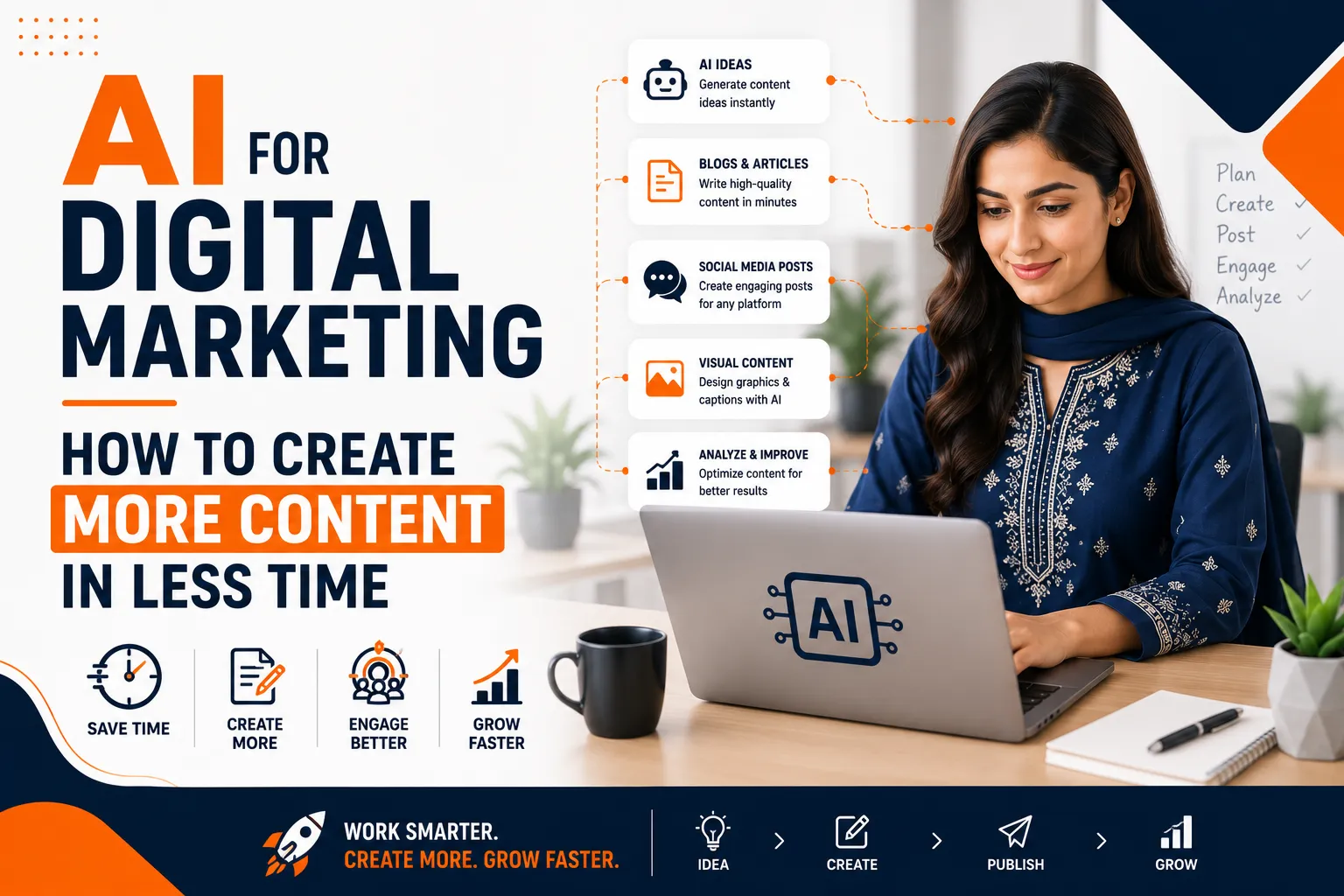
AI for Digital Marketing: How to Create More Content in Less Time

Introduction
Creating high-quality marketing content consistently is one of the biggest challenges businesses face today. Whether you’re running a small business or managing a marketing team, your audience expects you to stay active across multiple channels. From publishing SEO-friendly blogs and engaging social media posts to writing email campaigns, creating video scripts, and running advertisements, the workload can quickly become overwhelming.
The challenge isn’t a lack of ideas it’s finding enough time to turn those ideas into content that attracts, educates, and converts your audience.
This is where Artificial Intelligence (AI) has become a valuable addition to modern digital marketing. Instead of replacing marketers, AI helps simplify repetitive tasks, speed up research, and reduce the time spent on content creation. As a result, businesses can publish more consistently without sacrificing productivity.
However, there’s an important distinction that many businesses overlook.
AI can generate content, but it cannot understand your customers, define your brand strategy, or build meaningful relationships with your audience. Those responsibilities still require human expertise.
In this guide, you’ll learn how AI supports different areas of digital marketing, where it can genuinely save time, and why combining AI with human strategy produces far better results than relying on automation alone.
Why Content Creation Has Become More Difficult Than Ever
Not long ago, publishing a few social media posts every week was enough to maintain an online presence. Today, businesses are expected to create valuable content across multiple platforms while keeping up with changing customer expectations and search engine algorithms.
A typical marketing workflow may include:
- Writing SEO-optimized blog articles
- Managing social media platforms
- Creating Google and social media advertisements
- Sending email newsletters
- Producing video content
- Researching keywords
- Planning monthly content calendars
Each of these activities requires research, creativity, editing, and consistency. For many businesses, especially small and medium-sized companies, handling everything with a limited team becomes difficult.
The growing importance of content marketing has also changed how customers make buying decisions. Instead of contacting a business immediately, potential customers often spend time reading blogs, comparing services, watching videos, and looking for answers online before making a purchase.
This means businesses cannot afford to disappear from search results or stop publishing helpful content for long periods.
The good news is that AI can reduce the time spent on many repetitive marketing tasks, allowing businesses to focus more on strategy, creativity, and customer engagement.
Where AI Can Help in Digital Marketing
Artificial Intelligence is no longer limited to generating text. Modern AI tools can assist marketers throughout the entire content creation process from research and planning to writing, optimization, and campaign preparation.
Rather than replacing your marketing efforts, AI works best as a productivity partner. It helps eliminate repetitive tasks so you can spend more time making strategic decisions that drive business growth.
Let’s look at some of the areas where AI is making the biggest impact.
AI for SEO and Keyword Research
Every successful content marketing strategy begins with understanding what your audience is searching for. Without proper keyword research, even well-written content may struggle to reach the right people.
Traditionally, keyword research involved manually exploring search trends, analyzing competitors, grouping related keywords, and identifying search intent. While these activities are still important, AI can significantly speed up the research process.
Today, AI tools can help marketers:
- Discover relevant keyword ideas
- Identify long-tail search queries
- Group related topics into content clusters
- Analyze competitor content
- Generate frequently asked questions
- Suggest supporting keywords for comprehensive coverage
For example, if you want to write about digital marketing for exporters, AI can quickly suggest related topics such as website optimization, international SEO, buyer personas, lead generation, and Google Ads. This allows marketers to build stronger content strategies in less time.
However, speed should never replace strategic thinking.
Just because a keyword has search volume doesn’t automatically mean it’s valuable for your business. Experienced SEO professionals evaluate whether a keyword matches user intent, supports business goals, and fits naturally within an overall content strategy.
AI can present hundreds of keyword suggestions in minutes, but deciding which opportunities are worth pursuing still requires human judgment.
AI vs Traditional Keyword Research
| Traditional Approach | AI-Assisted Approach |
| Manual keyword brainstorming | Quickly generates relevant keyword ideas |
| Time-consuming competitor analysis | Identifies competitor topics faster |
| Separate research for FAQs | Suggests common user questions automatically |
| Manual topic clustering | Organizes related keywords into topic groups |
| Several hours of initial research | Significantly reduces research time |
When combined with professional SEO expertise, AI makes keyword research faster while ensuring businesses continue targeting the right audience instead of simply chasing search volume.
AI for Blog Writing
Writing informative, well-structured blog articles takes time. Researching the topic, creating an outline, drafting content, editing, optimizing for search engines, and refining readability can easily take several hours for a single article.
AI helps reduce much of this workload.
Instead of starting from a blank page, marketers can use AI to create structured outlines, generate introductory ideas, suggest headings, draft FAQs, improve readability, and refine sentence flow.
This allows content creators to focus more on adding insights, practical examples, and industry expertise rather than spending hours on repetitive drafting.
For example, AI can help create:
- Blog outlines
- First drafts
- Meta descriptions
- SEO-friendly headings
- Frequently Asked Questions
- Content summaries
- Suggested internal linking opportunities
But there’s a common mistake many businesses make.
Some publish AI-generated content without reviewing or improving it. While AI can produce grammatically correct text, it often lacks original insights, real-world examples, and the unique perspective that builds trust with readers.
High-quality content still depends on human expertise.
Businesses that simply copy and paste AI-generated text often produce generic articles that fail to engage readers or differentiate their brand.
The best approach is to let AI handle repetitive writing tasks while experienced marketers refine the content, verify information, improve clarity, and ensure every article reflects the company’s voice and objectives.
How AI Improves the Blog Writing Process
| Without AI | With AI |
| Starting every article from scratch | Generates a structured first draft to build upon |
| Manual outline creation | Creates organized outlines in minutes |
| Brainstorming FAQs manually | Suggests relevant questions automatically |
| Repetitive editing | Assists with grammar and readability improvements |
| More time spent on drafting | More time available for strategy and quality improvements |
Remember, AI can write sentences, but it cannot replace industry experience, customer understanding, or strategic thinking. Those qualities are what turn an average blog into content that genuinely helps readers and supports business growth.
AI for Content Planning
Creating content consistently is often more difficult than writing individual pieces. Many businesses don’t struggle because they lack ideas they struggle because they don’t have a clear plan.
Without a content strategy, marketing becomes reactive. Teams spend valuable time deciding what to publish next instead of focusing on creating valuable content for their audience.
AI can make content planning far more efficient by helping marketers organize ideas into structured content calendars.
Instead of brainstorming every week, AI can assist with:
- Monthly content calendars
- Topic ideas based on customer interests
- Content pillars for different services
- Seasonal campaign planning
- Topic clusters for SEO
- Content repurposing opportunities
For example, a single blog article doesn’t have to remain just a blog. With proper planning, the same piece of content can be transformed into multiple formats for different platforms.
| Original Content | Repurposed Content |
| Blog article | LinkedIn post |
| Blog article | Facebook post |
| Blog article | Instagram carousel |
| Blog article | Email newsletter |
| Blog article | YouTube video script |
| Blog article | Short-form video for Reels or Shorts |
This approach not only saves time but also helps businesses maintain a consistent presence across multiple platforms without constantly creating content from scratch.
Still, AI cannot decide what matters most to your audience.
It doesn’t know your business priorities, understand customer pain points, or recognize which topics are most likely to generate qualified leads. Those decisions require a marketing strategy built around your business goals.
The most successful businesses use AI to improve efficiency while relying on human expertise to shape content that informs, builds trust, and drives meaningful results.
AI for Google Ads and Social Media Ads
Creating high-performing advertisements isn’t just about writing catchy headlines. Every successful ad campaign requires multiple variations of headlines, descriptions, calls-to-action, and messaging to identify what resonates with the target audience.
This is another area where AI can save marketers a significant amount of time.
Instead of writing every variation manually, AI can quickly generate multiple versions of ad copy based on your campaign objective. Whether you’re promoting a new service, generating leads, or increasing website traffic, AI can provide fresh ideas that marketers can refine further.
AI can assist with:
- Generating multiple headline variations
- Writing ad descriptions
- Suggesting different calls-to-action
- Adapting copy for different platforms
- Brainstorming campaign ideas
- Creating A/B testing variations
For example, if you’re running a campaign for website development services, AI can generate several headline options within seconds. Your marketing team can then select the strongest versions, adjust them to match your brand voice, and test which one performs best.
However, successful advertising goes far beyond writing ad copy.
AI doesn’t know your profit margins, ideal customer profile, competitive positioning, or campaign objectives. It can’t decide how much budget to allocate, which audience to target, or when to scale a winning campaign.
These strategic decisions require experienced marketers who understand customer behaviour and business goals.
AI for Email Campaigns
Email marketing remains one of the most effective digital marketing channels because it allows businesses to communicate directly with potential and existing customers.
The challenge is maintaining consistency. Writing newsletters, promotional emails, follow-ups, welcome sequences, and re-engagement campaigns can quickly become time-consuming.
AI helps simplify this process by assisting marketers with:
- Subject line ideas
- Welcome email sequences
- Promotional campaigns
- Follow-up emails
- Newsletter drafts
- Product launch announcements
- Personalized content suggestions
Instead of spending hours drafting every email from scratch, marketers can use AI to create a solid first draft and then customize it based on the audience, campaign goals, and brand voice.
The result is a faster workflow without compromising communication quality.
That said, personalization should never be sacrificed for speed. Customers are more likely to engage with emails that feel relevant and authentic rather than generic messages generated entirely by AI.
AI for Video Script Writing
Video content continues to dominate digital marketing because it helps businesses educate, engage, and build trust with their audience.
Whether you’re creating YouTube videos, product demonstrations, educational tutorials, or short-form videos for social media, developing scripts can often be one of the most time-consuming parts of the production process.
AI can help marketers:
- Structure video outlines
- Generate talking points
- Create introductions and conclusions
- Suggest engaging hooks
- Organize complex topics into logical sections
- Repurpose blog content into video scripts
A practical workflow might look like this:
| Stage | Responsibility |
| Research the topic | Human + AI |
| Create the initial outline | AI |
| Add business insights and examples | Human |
| Review and refine the script | Human |
| Record and edit the video | Human |
| Optimize the title and description | Human + AI |
This approach allows businesses to produce educational content more efficiently while ensuring the final message reflects their expertise and connects with the intended audience.
What AI Still Cannot Replace
AI has transformed the way marketers work, but it’s important to understand its limitations. While it can accelerate content creation, it cannot replace the strategic thinking and experience that drive successful marketing campaigns.
| Human Expertise | Why It Still Matters |
| Business Strategy | Aligns marketing with long-term business objectives and growth plans. |
| Customer Psychology | Understands customer motivations, objections, and buying behaviour. |
| Brand Voice | Maintains a consistent, authentic identity across all communication. |
| Creativity | Develops original ideas, storytelling, and campaigns that stand out. |
| Experience | Applies real-world insights gained from successful and unsuccessful campaigns. |
Think of AI as a highly capable assistant. It can execute tasks efficiently, but it still relies on human direction to produce meaningful results.
Businesses that combine AI with experienced marketers are far more likely to create content that builds trust, strengthens their brand, and generates measurable business growth.
Common Mistakes Businesses Make with AI
While AI offers tremendous opportunities, using it incorrectly can reduce content quality and weaken your marketing efforts.
| Common Mistake | Better Approach |
| Publishing AI-generated content without editing | Review, fact-check, and refine every piece before publishing. |
| Focusing only on quantity | Prioritize helpful, high-quality content that solves real problems. |
| Ignoring search intent | Create content that answers what your audience is actually looking for. |
| Using the same prompts repeatedly | Provide clear context and customize prompts for better results. |
| Expecting AI to replace marketers | Use AI to improve efficiency while keeping strategy in human hands. |
Avoiding these mistakes helps ensure AI becomes a competitive advantage rather than a shortcut that produces average results.
Best Practices for Using AI in Your Marketing Workflow
The most successful businesses don’t rely entirely on AI or ignore it altogether. Instead, they integrate AI into their existing workflow while keeping strategic decisions in human hands.
Here are a few best practices:
- Use AI to speed up research and brainstorming.
- Let AI generate outlines and first drafts instead of final content.
- Add your expertise, industry knowledge, and real-world examples.
- Verify facts and statistics before publishing.
- Optimize every piece of content for search intent and user experience.
- Maintain a consistent brand voice across all platforms.
- Monitor performance using analytics and improve your content over time.
By following this approach, businesses can increase productivity without compromising quality or credibility.
AI + Human Strategy Delivers Better Marketing Results
Artificial Intelligence has become an essential part of modern digital marketing, helping businesses create content more efficiently than ever before. It can streamline research, accelerate content creation, and support marketers across SEO, advertising, email marketing, and video production.
However, technology alone doesn’t build successful brands.
The businesses that achieve long-term success are those that combine AI’s efficiency with human creativity, strategic thinking, and a deep understanding of their customers. AI can generate ideas and automate repetitive tasks, but it cannot replace the experience needed to make informed marketing decisions or build genuine customer relationships.
Instead of viewing AI as a replacement for marketers, think of it as a tool that empowers your team to focus on the work that truly matters—developing strategies, solving customer problems, and creating content that inspires trust and drives business growth.
Ready to Build a Smarter Digital Marketing Strategy?
AI can help you create content faster, but creating effective content requires much more than automation. A successful digital marketing strategy combines SEO, content marketing, advertising, and customer insights to attract the right audience and convert them into loyal customers.
At Logical Tech Zone, we help businesses use AI strategically not as a shortcut, but as a productivity tool that supports sustainable growth. Whether you’re looking to improve your SEO, create high-quality content, run better advertising campaigns, or strengthen your overall digital presence, our team can help you build a marketing strategy that delivers measurable results.


Good article, it is very helpful and rich in information. App Development Company in Hyderabad