
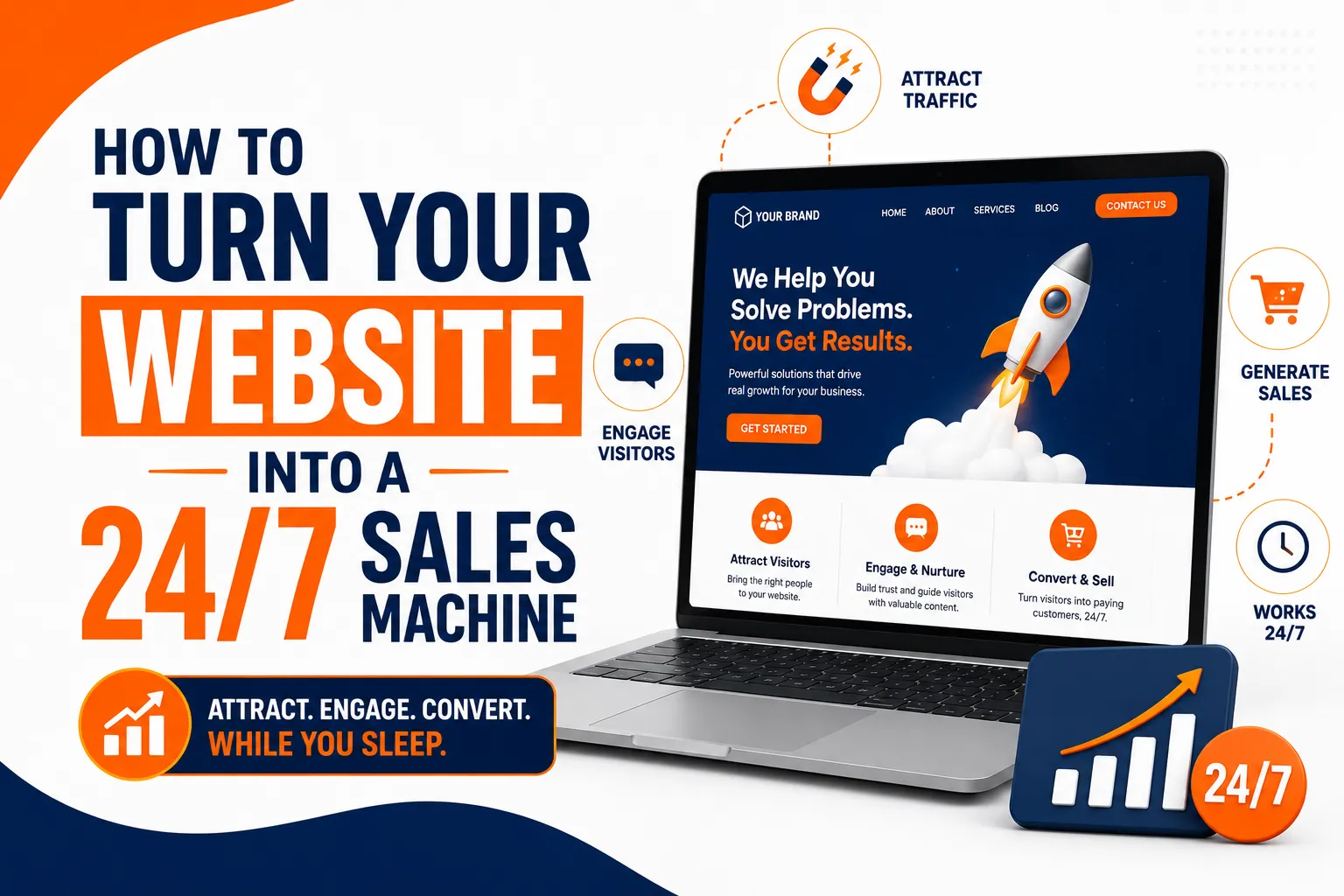
How to Turn Your Website into a 24/7 Sales Machine

Introduction: Is Your Website Helping You Grow or Just Taking Up Space Online?
Many business owners invest in a website because they know they need an online presence. The website gets launched, a few pages are added, and then it is largely forgotten.
Months later, the same business owners wonder:
- Why am I not getting inquiries through my website?
- Why aren’t customers contacting me?
- Why am I not getting leads from Google?
- Why do competitors seem to get more business online?
The reality is that simply having a website does not guarantee results.
A website should do much more than display information about your business. When built correctly, it can attract potential customers, answer their questions, build trust, generate leads, and even help close sales while you are busy running your business or sleeping.
Think of your website as a sales representative that works 24 hours a day, 7 days a week, without taking breaks, sick leave, or vacations.
Whether you run a B2B company, a B2C business, an export company, a manufacturing unit, or a service-based business, your website has the potential to become one of your most valuable business assets.
In this guide, you’ll learn exactly how to transform your website into a powerful sales machine that consistently helps your business grow.
Why Most Business Websites Fail to Generate Leads and Sales
Before discussing what works, it is important to understand why so many websites fail.
Many websites are designed with appearance in mind but not with business goals in mind.
A beautiful website that generates no inquiries is simply an expensive online brochure.
Common Reasons Business Websites Fail
| Problem | What Happens |
| Unclear messaging | Visitors leave because they don’t understand what you do |
| Slow website speed | People become frustrated and leave |
| No call-to-action | Visitors don’t know what to do next |
| Poor mobile experience | Mobile users leave without contacting you |
| Weak SEO | Your website doesn’t appear in Google searches |
| No trust signals | Visitors don’t feel confident enough to contact you |
| Poor content | Visitors don’t find the information they need |
For example, many exporters invest in websites that showcase products but fail to explain why international buyers should trust them.
If you’re facing similar challenges, our guide “Website Mistakes That Are Killing Your Export Orders” explores some of the most common issues that prevent businesses from converting website visitors into customers.
What Makes a Website a Sales Machine?
A traditional website simply provides information.
A sales-focused website is strategically designed to guide visitors toward taking action.
Let’s compare the two.
| Traditional Website | Sales Website |
| Acts as a company profile | Acts as a lead generation tool |
| Focuses on information | Focuses on conversions |
| Visitors browse randomly | Visitors follow a structured journey |
| No clear next steps | Strong calls-to-action throughout |
| Difficult to measure performance | Every action can be tracked |
Imagine two businesses selling the same product.
The first website only displays product images and company information.
The second website:
- Answers customer questions
- Shows testimonials
- Includes case studies
- Offers a free consultation
- Has clear contact forms
- Appears in Google searches
Which one do you think generates more inquiries?
The answer is obvious.
This is exactly why choosing the right website strategy matters. If you’re unsure what type of website your business actually needs, read our guide:
Business Website vs Sales Website – What You Actually Need
The Core Elements Every High-Converting Website Needs
No matter what industry you’re in, every successful website includes a few essential ingredients.
Think of these as the foundation of your digital sales process.
1. Clear and Simple Messaging
When someone lands on your website, they should immediately understand:
- Who you are
- What you offer
- Who you help
- Why they should choose you
Most visitors decide within a few seconds whether they want to stay or leave.
If your message is confusing, complicated, or unclear, visitors will leave and likely never return.
Instead of writing:
“Providing innovative solutions for modern businesses.”
Try something clearer:
“We help exporters generate international leads through professional websites and digital marketing.”
Simple messages convert better.
2. Strong Calls-to-Action (CTAs)
A visitor should never wonder what to do next.
Every important page should encourage action.
Examples include:
- Request a Quote
- Get a Free Consultation
- Download Our Catalogue
- Contact Our Team
- Book a Discovery Call
Without clear CTAs, visitors may leave even if they’re interested in your services.
Think of a CTA as the bridge between interest and action.
3. Mobile-Friendly Design
Today, most people browse websites using smartphones.
If your website doesn’t work properly on mobile devices, you’re likely losing customers every day.
A mobile-friendly website should:
- Load quickly
- Be easy to navigate
- Display content correctly
- Have clickable buttons
- Make forms easy to complete
Google also favors mobile-friendly websites in search rankings.
4. Fast Loading Speed
People hate waiting.
Research consistently shows that visitors leave websites that take too long to load.
A slow website can hurt:
- User experience
- Search rankings
- Conversion rates
- Customer trust
Even a one-second improvement in loading speed can positively impact conversions.
5. Trust Signals
Before contacting you, customers want reassurance.
They want proof that you’re a legitimate and reliable business.
Trust-building elements include:
- Client testimonials
- Google reviews
- Certifications
- Awards
- Years of experience
- Portfolio samples
- Case studies
The more proof you provide, the easier it becomes for visitors to trust you.
For a deeper breakdown, read:
7 Features Every High-Converting Website Must Have
How B2B Businesses Can Turn Their Website into a Sales Machine
Business-to-business buyers behave differently than everyday consumers.
Before making a decision, they often:
- Conduct research
- Compare suppliers
- Review capabilities
- Request quotations
- Consult internal teams
This means your website must support a longer buying process.
What B2B Buyers Want to See
Detailed Product and Service Information
B2B buyers are looking for facts.
They want detailed information about:
- Products
- Services
- Manufacturing capabilities
- Industries served
- Certifications
- Quality standards
The more information you provide, the more confident buyers become.
Easy Inquiry and RFQ Forms
Don’t force visitors to search for your contact information.
Make it easy to:
- Request a quote
- Ask questions
- Schedule meetings
- Submit requirements
Every extra step reduces the chances of receiving an inquiry.
Case Studies and Success Stories
Buyers want proof that you can deliver results.
A strong case study should explain:
- The client’s challenge
- Your solution
- The outcome
This demonstrates expertise better than simply claiming to be experienced.
Downloadable Resources
Many B2B buyers prefer reviewing information internally before contacting suppliers.
Useful resources include:
- Company profiles
- Product catalogues
- Brochures
- Technical documents
These materials help move prospects through the buying process.
Search Engine Optimization (SEO)
If your ideal customers are searching online, your website should appear in those searches.
SEO helps attract highly targeted visitors who are already looking for what you offer.
Export businesses especially benefit from SEO because international buyers often start their supplier search on Google.
To learn more, read:
How to Generate International Leads for Your Export Business
How B2C Businesses Can Turn Their Website into a Sales Machine
B2C customers usually make decisions faster than B2B buyers.
Their buying behavior is often influenced by:
- Convenience
- Price
- Trust
- User experience
This means your website must remove obstacles and make purchasing easy.
What B2C Websites Need
Attractive Product Pages
Every product page should include:
- High-quality images
- Clear descriptions
- Benefits
- Pricing
- Customer reviews
Customers should have all the information needed to make a decision.
Simple Checkout Experience
Complicated checkout processes lead to abandoned carts.
A smooth checkout should:
- Require fewer steps
- Be mobile-friendly
- Offer multiple payment options
The easier the process, the more sales you’ll generate.
Customer Reviews
Modern consumers trust other customers.
Positive reviews help reduce hesitation and increase confidence.
Live Chat Support
Sometimes customers have simple questions.
Quick answers can often mean the difference between a sale and a lost opportunity.
Retargeting Visitors
Most visitors won’t buy during their first visit.
Retargeting allows you to reconnect with interested visitors and bring them back to complete their purchase.
How Service-Based Businesses Can Generate More Leads Through Their Website
If you sell services rather than products, your website’s primary goal should be lead generation.
Examples include:
- Digital marketing agencies
- Website development companies
- Consultants
- Accountants
- Architects
- Legal firms
For service providers, trust and expertise are everything.
Create Service Pages That Solve Problems
Most businesses make the mistake of describing services.
Successful businesses focus on solving problems.
Instead of saying:
“We provide SEO services.”
Explain:
“Struggling to generate leads from Google? Our SEO services help your business attract qualified visitors and increase inquiries.”
Always focus on outcomes.
Create Dedicated Landing Pages
Each service deserves its own page.
For example:
- SEO Services
- Website Development
- Graphic Design
- Digital Marketing
- Social Media Marketing
Dedicated pages improve both SEO and conversion rates.
You can learn more in our guide:
Landing Pages vs Full Website – Which One Gets More Clients?
Showcase Your Work
Potential clients want evidence.
Display:
- Portfolio projects
- Before-and-after results
- Client success stories
- Testimonials
Showing results builds confidence.
Offer Lead Magnets
Lead magnets encourage visitors to share their contact details.
Examples include:
- Free Website Audit
- Free SEO Assessment
- Free Marketing Consultation
- Free Digital Strategy Session
This helps you start meaningful conversations with potential clients.
Use SEO to Attract Qualified Visitors Every Day
Even the best website cannot generate leads without traffic.
SEO helps your website attract people who are actively searching for your products or services.
Unlike paid advertising, SEO can continue delivering traffic long after content is published.
Important SEO Areas
Keyword Research
Understand what your customers are searching for.
Content Creation
Publish helpful articles that answer common questions.
Technical SEO
Ensure your website is:
- Fast
- Secure
- Mobile-friendly
Internal Linking
Connect related pages and blog posts.
For example:
- Complete Digital Roadmap for Export Businesses in Pakistan
- How to Generate International Leads for Your Export Business
- Website Mistakes That Are Killing Your Export Orders
These connections help both users and search engines understand your content.
Automate Lead Generation and Follow-Up
One of the biggest advantages of a website is automation.
A well-designed website can capture leads even when nobody from your team is available.
Example Lead Generation Process
| Stage | Action |
| Visitor arrives | Reads content |
| CTA clicked | Form completed |
| CRM records lead | Information stored |
| Automated email sent | Immediate response |
| Sales team notified | Follow-up begins |
Automation ensures every lead receives attention.
How to Measure Website Success
Many businesses focus only on traffic.
Traffic alone doesn’t pay the bills.
Instead, measure:
| Metric | Why It Matters |
| Website visitors | Shows visibility |
| Conversion rate | Shows effectiveness |
| Leads generated | Shows business opportunities |
| Inquiry quality | Shows targeting success |
| Revenue generated | Shows real business impact |
The goal is not more visitors.
The goal is more customers.
Frequently Asked Questions
A sales-focused website is designed to generate inquiries, leads, and customers rather than simply displaying information.
Paid traffic can generate leads immediately, while SEO may take several months to produce consistent results.
Yes. SEO helps potential customers find your business through search engines.
A landing page focuses on a single goal, while a website supports multiple customer journeys.
Slow websites frustrate users, reduce conversions, and negatively affect search rankings.
Yes. B2B websites focus more on trust, information, and lead generation, while B2C websites focus on convenience and purchasing.
Every important page should include at least one clear CTA.
Trust signals include testimonials, reviews, certifications, awards, case studies, and portfolio examples.
Yes. SEO, content marketing, referrals, and social media can generate leads organically.
Regular updates help maintain rankings, improve relevance, and keep visitors engaged.
Final Thoughts
Your website should not be a passive online brochure that only exists because every business is expected to have one.
It should actively contribute to your growth by attracting visitors, building trust, generating leads, and creating sales opportunities around the clock.
Whether you operate a B2B company, a B2C brand, an export business, or a service-based company, the principles remain the same:
Attract the right visitors → Build trust → Guide them toward action → Capture leads → Follow up effectively → Convert them into customers.
When all of these elements work together, your website becomes much more than a marketing tool—it becomes a 24/7 sales machine that continuously supports your business growth.
Ready to Turn Your Website into a Lead-Generating Asset?
If your current website isn’t generating the inquiries, leads, or sales you expected, it may be time for a strategic upgrade.
At Logical Tech Zone, we help businesses build high-converting websites, SEO strategies, landing pages, and digital marketing systems designed to generate measurable business results.
Whether you’re starting from scratch or improving an existing website, the right strategy can transform your online presence into one of your most powerful sales channels.


