


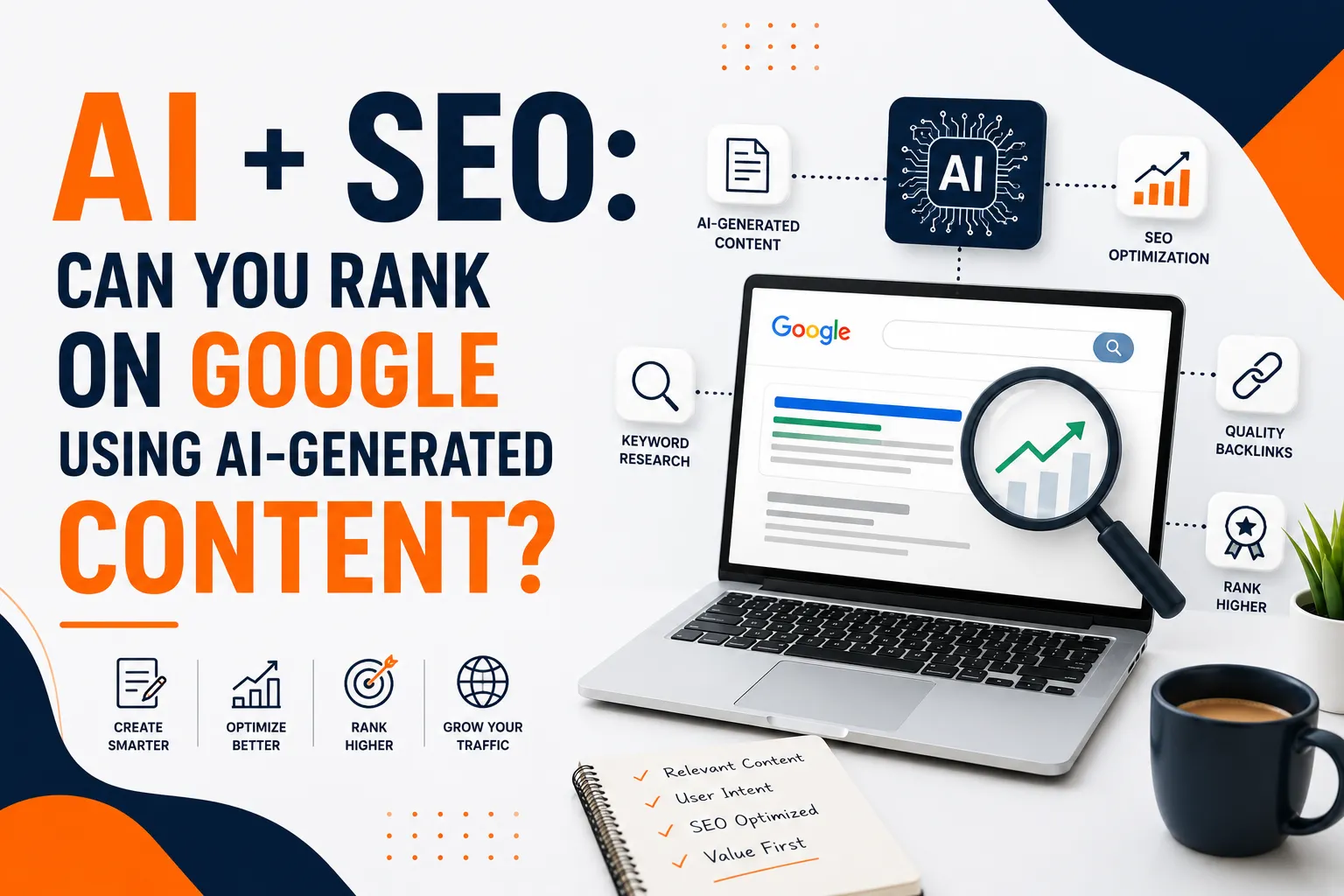
AI + SEO: Can You Rank on Google Using AI-Generated Content?

Introduction
Artificial Intelligence has transformed the way businesses create content. Today, with just a few prompts, AI tools can generate blog posts, product descriptions, website copy, emails, and even social media content within minutes.
As a result, one question has become increasingly common among business owners, marketers, and content creators:
Can AI-generated content actually rank on Google?
The short answer is yes but not for the reason many people think.
There’s a common misconception that simply copying content generated by AI and publishing it on a website is enough to improve search rankings. In reality, that’s where many businesses go wrong.
Google doesn’t reward content because it was written by a human, nor does it penalize content simply because AI was involved in the writing process. Instead, Google evaluates whether the content is genuinely helpful, relevant, trustworthy, and capable of satisfying the user’s search intent.
This means AI should be viewed as a productivity tool rather than a replacement for SEO expertise.
At Logical Tech Zone, we use AI to streamline research, organize ideas, and improve efficiency. But every piece of content goes through strategic planning, SEO optimization, and human refinement before it’s published. That combination allows us to create content that not only answers users’ questions but also aligns with modern search engine expectations.
In this article, we’ll explore Google’s position on AI-generated content, explain why simply publishing AI-written text rarely delivers long-term results, and show how businesses can combine AI with human expertise to create content that has the potential to rank and convert.
Google’s Stance on AI-Generated Content
One of the biggest myths surrounding AI content is that Google automatically penalizes websites for using AI writing tools.
That isn’t true.
Google has made it clear that it focuses on the quality of content, not the method used to create it. Whether an article is written entirely by a person, created with AI assistance, or produced using a combination of both, Google’s primary concern is whether it provides value to users.
In simple terms, Google asks questions like:
- Does this content answer the user’s query?
- Is the information accurate and trustworthy?
- Does it provide original value?
- Is it written for people rather than just search engines?
- Does it demonstrate genuine expertise?
If the answer is yes, the content has a much better chance of performing well in search results.
This is an important shift in how businesses should think about AI.
Instead of asking, “Can I use AI?”, the better question is:
“Can I use AI to create genuinely helpful content?”
That distinction makes all the difference.
Why Simply Copying AI Content Rarely Works
One of the biggest mistakes businesses make is assuming AI can completely replace the content creation process.
For example, someone opens an AI tool and types:
“Write a blog about SEO.”
Within a few seconds, the AI produces a complete article.
At first glance, the content may appear impressive. It’s grammatically correct, well-structured, and covers the topic reasonably well.
So why doesn’t this approach consistently produce strong SEO results?
Because AI is designed to generate information based on patterns it has learned. Without detailed instructions or business context, it usually produces content that is broad, generic, and similar to what thousands of other users receive.
In other words, basic prompts often lead to basic content.
That’s why many AI-generated articles share common problems:
- They repeat ideas without adding depth.
- They provide surface-level explanations.
- They lack practical examples.
- They don’t reflect the business’s unique experience.
- They sound generic rather than authoritative.
Search engines and more importantly, readers are looking for something more valuable than information that can be generated in a few seconds.
They want content that solves real problems, offers practical guidance, and reflects genuine expertise.
This is where human involvement becomes essential.
The Difference Between Using AI and Using AI Strategically
The conversation shouldn’t be about whether AI is good or bad for SEO.
The real question is how you’re using it.
There’s a significant difference between asking AI to write an article and using AI as part of a strategic content creation process.
| Basic AI Usage | Strategic AI Workflow |
| Uses simple prompts | Uses detailed prompt engineering |
| Generates generic content | Produces business-specific content |
| Published without review | Carefully reviewed and refined |
| Focuses on word count | Focuses on solving user problems |
| Limited SEO optimization | Built around search intent and SEO strategy |
| Similar to thousands of other articles | Includes original insights and practical experience |
The technology is the same.
The outcome is completely different.
From our experience, AI performs best when it’s treated as a collaborative assistant rather than an independent writer.
For instance, when we create content, we don’t ask AI to “write a blog” and publish whatever it generates.
Instead, we provide detailed instructions that include:
- The target audience
- The primary keyword
- Search intent
- Desired tone of voice
- Content structure
- Business objectives
- SEO requirements
- Real-world examples to include
- Topics to avoid
- Areas where human expertise should be added
The result is content that is far more relevant, engaging, and aligned with both user expectations and search engine guidelines.
The difference isn’t just the AI tool, it’s the strategy behind how the tool is used.
Our AI-Assisted Content Workflow at Logical Tech Zone
At Logical Tech Zone, AI isn’t responsible for creating finished content. Instead, it helps us work more efficiently while allowing our team to focus on strategy, quality, and user value.
Our content creation process begins long before AI generates a single sentence.
The first step is understanding why someone is searching for a particular topic.
Every keyword has a purpose. Some users are looking for information, while others are comparing solutions or preparing to make a purchase. Identifying this search intent helps us create content that answers the right questions instead of simply targeting keywords.
Once the search intent is clear, we perform keyword research to identify the primary keyword, supporting keywords, and related topics that should naturally be covered throughout the article.
Only after this research is complete do we use AI to assist with tasks such as:
- Building a logical content outline
- Organizing topic clusters
- Generating initial drafts
- Suggesting FAQs
- Identifying supporting subtopics
However, this draft is never considered the finished product.
Our team then reviews every section, expands explanations, adds practical business examples, improves readability, removes repetitive content, and ensures the article reflects real-world experience rather than generic information.
This human refinement is what transforms an AI-assisted draft into content that is genuinely useful for readers.
Why Prompt Engineering Matters More Than Most People Think
One of the biggest misconceptions about AI-generated content is that every user gets the same quality of output from the same AI tool.
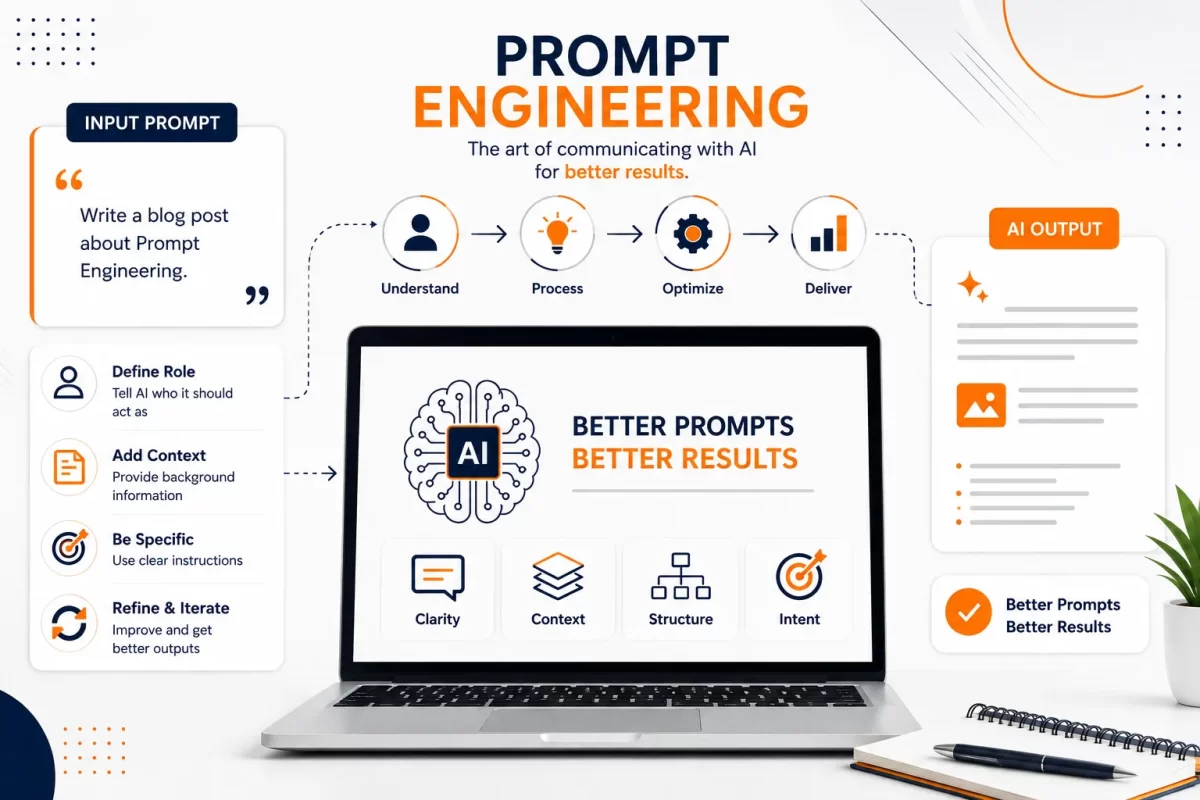
In reality, the quality of the content depends heavily on the quality of the instructions given to the AI.
This is where prompt engineering makes a significant difference.
Think of AI as an intelligent assistant. If you give it a vague instruction like:
“Write a blog about SEO.”
It will generate a general article covering the basics. While the content may be grammatically correct, it often lacks originality, business context, and strategic direction.
Now compare that with a detailed prompt that includes:
- The target audience
- Search intent
- Primary and secondary keywords
- Desired tone of voice
- Blog structure
- Business objectives
- Industry-specific examples
- SEO requirements
- Topics to avoid
- Call-to-action requirements
The output becomes much more focused and aligned with your goals.
This is exactly how we approach AI-assisted content at Logical Tech Zone.
We don’t rely on AI to think for us we guide it with clear instructions based on our SEO knowledge, marketing experience, and understanding of user intent.
More importantly, we don’t stop after receiving the first draft.
Every piece of content is reviewed, improved, and refined before publication.
This is where many businesses make the wrong assumption. They believe AI alone creates high-quality content, when in reality, it’s the expertise behind the prompts and the editing process that makes the biggest difference.
Google’s EEAT Still Matters
Regardless of whether content is written by humans or with AI assistance, Google’s quality expectations remain the same.
One of the most important concepts in modern SEO is EEAT, which stands for:
| EEAT Principle | What It Means |
| Experience | Demonstrating first-hand knowledge or practical experience on the topic. |
| Expertise | Showing subject matter knowledge that helps users make informed decisions. |
| Authoritativeness | Building credibility through consistently valuable content and industry recognition. |
| Trustworthiness | Providing accurate, transparent, and reliable information that users can depend on. |
Many AI-generated articles struggle because they explain topics from a general perspective but fail to demonstrate real experience.
For example, an AI tool can explain what keyword research is.
However, it cannot share lessons learned from managing SEO campaigns, improving rankings for clients, or solving real-world marketing challenges unless those insights are provided by an experienced professional.
This is one of the reasons we always enhance AI-generated drafts with practical examples, business insights, and explanations based on our own experience.
These additions make the content more valuable for readers while strengthening the trust signals that search engines look for.
Common Mistakes Businesses Make with AI Content
AI has made content creation faster, but speed alone doesn’t guarantee quality.
Many businesses unknowingly reduce the effectiveness of their SEO by using AI incorrectly.
The following are some of the most common mistakes we see.
| Common Mistake | Better Approach |
| Publishing AI output without reviewing it | Edit, fact-check, and improve every article before publishing. |
| Writing only for keywords | Focus on solving the reader’s problem first and optimize naturally. |
| Using the same generic prompts repeatedly | Develop detailed prompts tailored to each topic and audience. |
| Ignoring search intent | Create content that directly answers the questions users are asking. |
| Depending entirely on AI | Combine AI efficiency with human expertise and strategic thinking. |
Avoiding these mistakes doesn’t require abandoning AI.
It simply requires using it more intelligently.
Can AI-Generated Content Really Rank on Google?
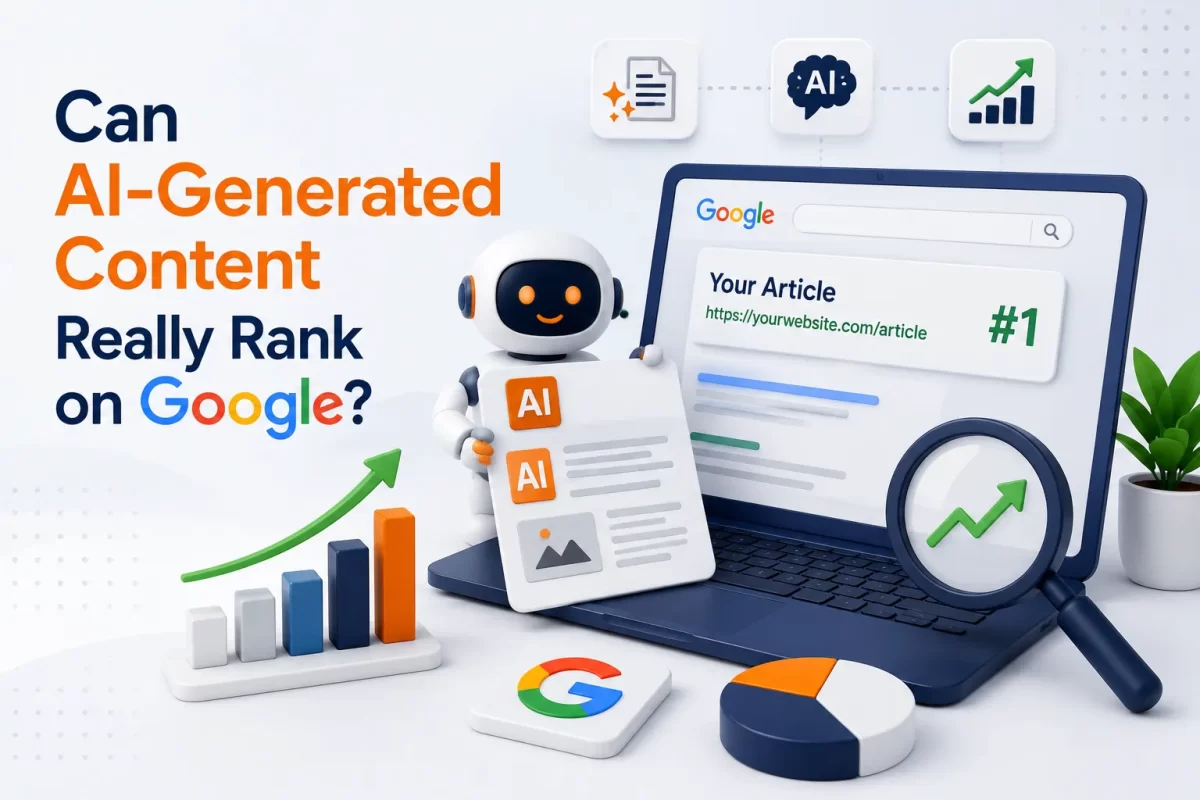
Let’s answer the question directly.
Yes, AI-assisted content can rank on Google.
But it doesn’t rank because AI wrote it.
It ranks because it meets the same quality standards that Google expects from any piece of content.
Successful AI-assisted content typically shares several characteristics.
It answers the user’s query clearly.
It satisfies search intent.
It includes original insights rather than repeating information found elsewhere.
It demonstrates expertise and practical experience.
It is well-structured, easy to read, and optimized for both users and search engines.
In other words, AI helps improve the content creation process, but human expertise determines the final quality.
This distinction is important because many businesses focus on the tool instead of the strategy.
The competitive advantage isn’t using AI.
Today, almost everyone has access to AI.
The real advantage comes from knowing how to use AI effectively.
Businesses that rely entirely on AI often produce content that feels generic and interchangeable.
Businesses that combine AI with SEO expertise, thoughtful editing, and real industry experience create content that is far more likely to build trust, attract qualified visitors, and perform well over time.
Best Practices for Creating AI-Assisted SEO Content
If you want AI to become an asset instead of a shortcut, follow a structured workflow that keeps quality at the center of the process.
- Start with keyword research and understand the user’s search intent before writing.
- Use AI to brainstorm ideas, organize outlines, and prepare the first draft.
- Add your own expertise, practical examples, and industry-specific insights.
- Review every claim for accuracy and update outdated information where necessary.
- Optimize headings, internal links, readability, and content structure for SEO.
- Ensure the article reflects your brand voice instead of sounding generic.
- Treat AI as a writing assistant, not the final decision-maker.
This approach allows you to create content more efficiently without compromising quality or credibility.
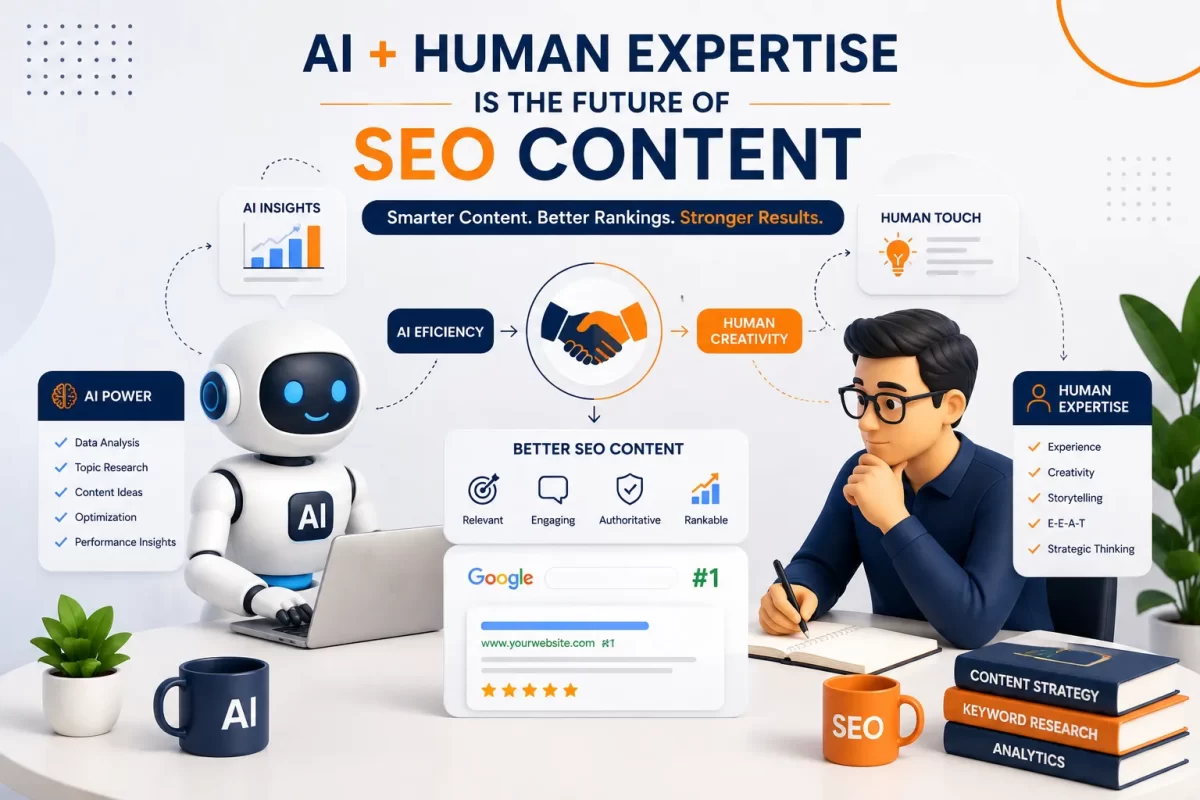
AI + Human Expertise Is the Future of SEO Content
The discussion around AI-generated content often focuses on the wrong question.
Instead of asking whether AI can replace human writers, businesses should ask how AI can help experienced marketers create better content in less time.
AI has undoubtedly changed the content creation process. It accelerates research, organizes ideas, improves productivity, and reduces repetitive work. But it cannot replace strategic thinking, customer understanding, creativity, or the experience gained from solving real business challenges.
At Logical Tech Zone, we believe the strongest SEO content is created when technology and human expertise work together.
AI helps us work faster.
Our experience ensures the content is accurate, valuable, and aligned with what both users and search engines expect.
That combination allows us to create content that not only has the potential to rank on Google but also builds trust, supports business goals, and delivers a better experience for readers.
Ready to Create SEO Content That Actually Performs?
Using AI to generate content is easy.
Creating content that ranks, engages your audience, and supports your business growth requires a well-planned SEO strategy.
At Logical Tech Zone, we combine AI-powered workflows with keyword research, search intent analysis, content optimization, and human expertise to create high-quality SEO content that delivers long-term value. If you’re looking to strengthen your content marketing strategy or improve your website’s organic visibility, our team is ready to help you create content that works for both your audience and search engines.
Frequently Asked Questions (FAQs)
No. Google does not penalize content simply because it was created with AI. Instead, it evaluates whether the content is helpful, accurate, original, and satisfies the user’s search intent. High-quality AI-assisted content can perform well when it provides genuine value to readers.
Yes, AI-generated content can rank on Google, but only when it is properly optimized and refined. Content that is strategically planned, edited by experts, and aligned with search intent has a much better chance of achieving strong rankings than content published directly from an AI tool without review.
AI can significantly improve SEO workflows by speeding up research, outlining articles, generating content ideas, and assisting with drafting. However, successful SEO still depends on factors such as keyword research, content quality, user experience, EEAT, and human expertise.
No. AI is a productivity tool rather than a replacement for SEO professionals. While AI can assist with repetitive writing tasks, experienced content writers and SEO specialists are still responsible for strategy, originality, fact-checking, optimization, and creating content that genuinely helps users.
Human editing improves clarity, accuracy, originality, and relevance. It also allows businesses to add practical examples, industry experience, and unique insights that AI cannot generate on its own. This creates more valuable content for both users and search engines.
At Logical Tech Zone, AI is used to improve efficiency not replace expertise. We use AI to support keyword research, content planning, outlining, and drafting, while our SEO specialists refine every article with search intent analysis, strategic optimization, business insights, and human editing before publication.


