

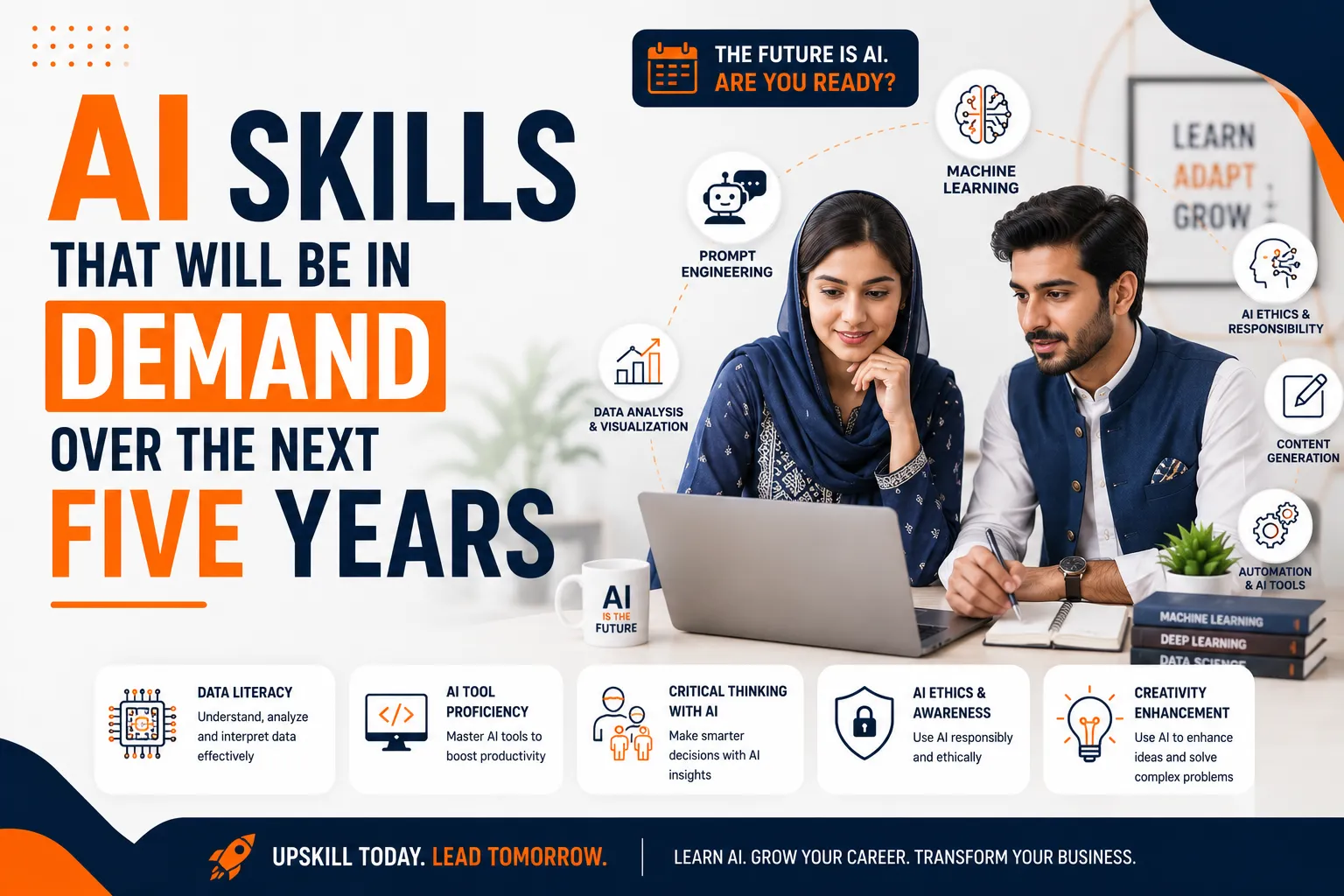
AI Skills That Will Be in Demand Over the Next Five Years

Introduction
Artificial Intelligence has become one of the most talked-about technologies in recent years. From content creation and digital marketing to customer support and software development, AI is transforming how businesses operate and how professionals work.
As this transformation continues, one question is becoming increasingly common among students, freelancers, and job seekers:
“Which AI skills should I learn to stay relevant over the next five years?”
It’s a valid question. News headlines often focus on AI replacing jobs, creating uncertainty about the future of work. However, our experience working with businesses across digital marketing, SEO, website development, and AI-assisted workflows tells a different story.
The professionals creating the most opportunities today aren’t the ones competing with AI.
They’re the ones learning how to work alongside it.
At Logical Tech Zone, we’ve integrated AI into many of our daily processes. We use it to accelerate research, organize information, generate first drafts, improve productivity, and automate repetitive tasks. But one lesson has become clear throughout this journey:
AI doesn’t replace expertise. It amplifies it.
Two people can use the same AI tool and achieve completely different results.
One produces generic work that requires significant revision.
The other creates content, strategies, and solutions that deliver real business value.
The difference isn’t the technology.
The difference is the skill of the person using it.
This is why businesses are no longer looking for people who simply know how to use ChatGPT or another AI assistant. They’re looking for professionals who can apply AI strategically to solve problems, improve workflows, and deliver measurable results.
In this guide, we’ll explore the AI skills that are expected to remain valuable over the next five years, explain why businesses are prioritizing them, and discuss how you can begin developing these skills today.
AI Isn’t Replacing Skills – It’s Changing Them
Every major technological shift changes the skills employers look for.
Years ago, basic computer literacy became an essential workplace skill.
Later, proficiency in tools like Microsoft Office, graphic design software, and digital marketing platforms became increasingly valuable.
Today, AI is creating another shift.
But the shift isn’t about replacing professionals.
It’s about changing the type of expertise that businesses need.
Many people believe employers will soon start hiring candidates simply because they know how to use AI tools.
In reality, businesses are asking a different question:
Can this person use AI to solve business problems?
There’s an important distinction between knowing how to use an AI platform and knowing how to apply AI effectively within a business environment.
For example, generating content with AI is relatively simple.
Creating content that reflects a company’s brand voice, satisfies search intent, supports SEO objectives, and helps generate leads requires strategic thinking.
The same principle applies across marketing, customer communication, research, automation, and design.
Technology continues to evolve.
The ability to think critically, communicate effectively, and make informed decisions remains just as valuable as ever.
What Businesses Are Actually Looking For
One of the biggest misconceptions among students is that employers are searching for people with the longest list of AI tools on their CV.
Our experience working with businesses suggests otherwise.
Most companies care less about the number of tools you know and more about the problems you can solve.
Instead of asking:
“Can you use ChatGPT?”
Employers increasingly ask questions like:
- Can you improve our marketing process?
- Can you automate repetitive tasks?
- Can you analyze information more efficiently?
- Can you create better content?
- Can you communicate professionally with clients?
- Can you help our team become more productive?
The focus has shifted from technical familiarity to practical business impact.
| Traditional Skill Focus | Today’s AI-Enhanced Skill Focus |
| Manual content writing | AI-assisted content strategy |
| Basic research | AI-supported research and analysis |
| Repetitive administrative work | Workflow automation |
| Creating content from scratch | Using AI to improve speed while maintaining quality |
| Learning individual software tools | Solving business problems with AI |
Businesses don’t gain a competitive advantage simply by adopting AI.
They gain an advantage by hiring people who understand how to integrate AI into real workflows.
1. Prompt Engineering
If there’s one AI skill that influences almost every other, it’s prompt engineering.
Despite the technical name, prompt engineering isn’t about programming.
It’s about learning how to communicate effectively with AI.
The quality of an AI-generated response depends heavily on the quality of the instructions you provide.
Consider two people using the same AI assistant.
One types:
“Write a blog about digital marketing.”
The other provides:
- The target audience
- Business objectives
- Primary keyword
- Search intent
- Desired tone of voice
- Blog structure
- SEO requirements
- Call-to-action
Although both use the same AI tool, the second person is far more likely to receive content that is relevant, structured, and useful.
This is something we’ve experienced repeatedly while working with AI.
Businesses often assume AI produces generic content by default.
In reality, generic prompts usually produce generic results.
The professionals achieving the best outcomes aren’t necessarily using better AI tools.
They’re giving better instructions.
That’s why prompt engineering has become one of the most valuable skills for marketers, business owners, freelancers, and content creators.
If you’re interested in practical examples, our guide “50 AI Prompts Every Business Owner Should Save” demonstrates how structured prompts can improve marketing, sales, customer support, and everyday business tasks.
2. AI-Assisted SEO
Search Engine Optimization continues to evolve, and AI is changing how SEO professionals work.
However, one of the biggest misconceptions is that AI can completely replace SEO expertise.
It can’t.
AI is excellent at supporting tasks such as:
- Generating content outlines
- Organizing keyword ideas
- Creating metadata
- Suggesting FAQ sections
- Structuring articles
- Brainstorming topic clusters
These capabilities can significantly reduce the time required to produce high-quality content.
But successful SEO still depends on human expertise.
Professionals must decide:
- Which keywords align with business objectives
- What search intent users have
- How content should be structured
- Which pages deserve priority
- How internal linking should support the website
- How to create original, experience-driven content that builds trust
This is exactly why businesses continue to hire SEO specialists even as AI becomes more capable.
The role of the SEO professional isn’t disappearing.
It’s evolving.
Rather than spending hours on repetitive drafting, SEO specialists can now focus more on strategy, optimization, user experience, and business outcomes.
We explored this topic in greater depth in our article “AI + SEO: Can You Rank on Google Using AI-Generated Content?”, where we explain why AI-assisted, human-refined content consistently outperforms content published without expert review.
3. AI Content Strategy
Many people associate AI with writing blog posts or generating social media captions.
While AI can certainly help with writing, businesses are increasingly looking for professionals who understand content strategy, not just content creation.
Content strategy is about deciding:
- What content should be created.
- Who it is for.
- Which platform it belongs on.
- How it supports business goals.
- How one piece of content can be repurposed into multiple formats.
This is one of the biggest shifts we’ve seen while working with businesses.
Companies rarely struggle because they lack content ideas. More often, they struggle because they don’t have a structured system for turning those ideas into consistent marketing assets.
For example, instead of creating separate content for every platform, one well-researched blog can become:
| Original Asset | Repurposed Content |
| Blog article | LinkedIn post |
| Blog article | Facebook post |
| Blog article | Email newsletter |
| Blog article | YouTube script |
| Blog article | Short-form video |
| Blog article | Website FAQ |
| Blog article | Google Business Profile update |
This workflow saves time while maintaining consistency across different marketing channels.
AI makes this process significantly faster, but deciding what to publish, how to communicate with your audience, and how each piece of content supports business growth still requires strategic thinking.
If you’d like to explore this workflow further, we recommend reading our guide, “AI for Digital Marketing: How to Create More Content in Less Time,” where we explain how businesses can combine AI with a structured content strategy.
4. AI Research & Business Analysis
Research has always been a valuable business skill.
The difference today is that AI allows professionals to organize and analyze information much more efficiently.
Businesses are increasingly looking for people who can use AI to:
- Summarize lengthy reports.
- Analyze competitors.
- Identify market trends.
- Organize customer feedback.
- Compare products and services.
- Support decision-making with structured insights.
However, one lesson we’ve learned from using AI daily is that faster research doesn’t eliminate the need for critical thinking.
AI can summarize information, but it doesn’t always understand the context behind that information.
For example, if you’re researching a new market or evaluating competitors, AI can help organize the available data, highlight patterns, and generate initial insights.
The final conclusions, however, should always be validated through reliable sources, business experience, and practical judgment.
The professionals who combine AI-assisted research with analytical thinking will continue to be highly valuable across almost every industry.
5. Workflow Automation
One of the most practical AI skills you can learn is workflow automation.
Many businesses spend hours every week completing repetitive tasks that could be simplified through automation.
Examples include:
- Sending follow-up emails.
- Organizing customer inquiries.
- Updating CRM records.
- Scheduling meetings.
- Preparing recurring reports.
- Managing internal documentation.
Learning how to connect AI with business workflows allows organizations to improve productivity without increasing their workload.
More importantly, automation allows employees to spend more time on activities that require creativity, communication, and decision-making.
Businesses aren’t looking for people who can simply complete repetitive tasks faster.
They’re looking for professionals who can redesign processes to make the entire business more efficient.
6. AI-Powered Graphic Design
AI has introduced new possibilities for designers, marketers, and content creators.
Today, AI can assist with:
- Brainstorming visual concepts.
- Creating marketing graphics.
- Generating presentation ideas.
- Producing social media visuals.
- Improving creative workflows.
However, creating attractive visuals still requires an understanding of design fundamentals.
Colour selection, typography, visual hierarchy, brand consistency, and user experience remain human skills.
In our own projects, AI helps us accelerate the creative process by generating ideas and visual directions.
The final designs are refined to ensure they align with the client’s branding, audience, and business objectives.
This combination of AI efficiency and design expertise consistently produces stronger results than relying on automation alone.
7. AI Video Production
Video continues to be one of the most effective ways for businesses to educate, build trust, and engage their audience.
AI has simplified many parts of the production process.
Today, professionals can use AI to assist with:
- Video topic research.
- Script writing.
- Storyboarding.
- Caption generation.
- Voiceover preparation.
- Thumbnail ideas.
- Content repurposing.
Our own content workflow demonstrates this approach.
A single blog article often becomes:
| One Content Idea | Multiple Marketing Assets |
| SEO Blog | YouTube video |
| SEO Blog | Shorts or Reels |
| SEO Blog | LinkedIn article |
| SEO Blog | Facebook content |
| SEO Blog | Email newsletter |
Rather than creating new ideas every day, businesses can maximize the value of existing content by repurposing it strategically.
This is one of the most valuable skills for modern marketers and content creators.
8. AI Communication Skills
Communication remains one of the most underrated AI skills.
While AI can draft emails, proposals, presentations, and reports, professionals still need to communicate clearly, professionally, and appropriately for different audiences.
This skill is especially valuable for:
- Freelancers communicating with clients.
- Exporters responding to international buyers.
- Sales professionals writing proposals.
- Marketing teams preparing presentations.
- Business owners managing customer relationships.
AI can improve speed and consistency, but effective communication still depends on understanding people, business objectives, and context.
Skills That Will Become Less Valuable
Technology doesn’t eliminate careers overnight.
Instead, it changes which skills employers prioritize.
| Skills Becoming Less Valuable | Skills Becoming More Valuable |
| Copying information manually | AI-assisted research and analysis |
| Generic content writing | Content strategy and human editing |
| Repetitive administrative work | Workflow automation |
| Basic software knowledge | AI-assisted productivity |
| Completing isolated tasks | Solving business problems with AI |
The goal isn’t to fear these changes.
The goal is to adapt before the market demands it.
Our Perspective: What We’ve Learned from Using AI Every Day
At Logical Tech Zone, AI has become part of our daily workflow.
We use it to accelerate research, organize ideas, prepare first drafts, improve productivity, and support content creation.
But after working with AI across SEO, digital marketing, website development, and business communication, we’ve noticed something interesting.
The professionals achieving the best results aren’t the ones using the largest number of AI tools.
They’re the ones who:
- Ask better questions.
- Understand business objectives.
- Review AI-generated outputs critically.
- Add their own expertise and experience.
- Continue learning as technology evolves.
In other words, AI rewards skilled professionals rather than replacing them.
That’s an important lesson for anyone preparing for the future job market.
How Students and Freelancers Can Start Today
You don’t need to master every AI tool before applying for jobs or starting freelance work.
A structured learning approach is often more effective.
| Week | Focus Area |
| Week 1 | Learn prompt engineering and understand how to communicate effectively with AI. |
| Week 2 | Practice AI-assisted SEO, content creation, and digital marketing. |
| Week 3 | Explore workflow automation, research techniques, and business productivity tools. |
| Week 4 | Build practical projects and create a portfolio that demonstrates your skills. |
Employers and clients are far more interested in seeing what you can do than simply hearing which tools you’ve used.
Why Practical Training Matters More Than Watching Tutorials
Watching videos can help you understand concepts.
Applying those concepts through real projects develops practical skills.
That’s the difference employers notice during interviews and clients recognize before awarding freelance projects.
Practical training helps you:
- Solve real business problems.
- Receive feedback from experienced mentors.
- Build a portfolio that demonstrates your capabilities.
- Learn complete workflows instead of isolated tools.
- Develop confidence through hands-on practice.
As AI continues to evolve, the professionals who combine technical knowledge with practical experience will remain the most competitive.
Frequently Asked Questions
Prompt engineering, AI-assisted SEO, workflow automation, AI content strategy, and AI-powered research are among the most valuable skills because they improve productivity across multiple industries.
No. AI can automate repetitive tasks and accelerate content creation, but successful digital marketing still requires strategy, creativity, audience understanding, and business expertise.
Yes. Learning how to communicate effectively with AI significantly improves the quality of AI-generated outputs and benefits professionals across marketing, business, education, and technology.
Not necessarily. Many AI-related careers focus on marketing, content creation, research, business analysis, automation, and communication rather than software development.
Freelancers can benefit from learning prompt engineering, AI-assisted content creation, client communication, proposal writing, workflow automation, and AI-supported research.
Absolutely. Starting with practical business applications and gradually building real-world projects is often more effective than trying to learn every AI tool at once.
Conclusion
The next five years won’t belong to the people who simply know how to use AI tools.
They’ll belong to the professionals who know how to apply AI to solve problems, improve workflows, communicate effectively, and create meaningful business results.
Technology will continue to evolve, and new AI platforms will emerge. But the ability to think strategically, adapt to change, and combine AI with human expertise will remain valuable regardless of which tools become popular.
If you’re a student preparing for your first job, a freelancer looking to offer more value to clients, or a professional planning your next career move, now is the right time to start developing practical AI skills that businesses genuinely need.
At Logical Tech Zone, our IT training programs are designed to help you go beyond learning AI tools. Through hands-on projects, practical assignments, and real-world workflows, you’ll learn how to apply AI in SEO, digital marketing, content creation, automation, and business communication skills that employers and clients are increasingly looking for in today’s competitive job market.


